
When it comes to developing AI agents, there is a lot of software and tools to keep in mind. Many of these tools are part of the AI tech stack, which is a layered system that helps agents accurately reason, act, and evolve.
A full AI agent tech stack includes tools such as data collection and integration, vertical agents, observability, agent frameworks, tool libraries, sandboxes and more. Each of these tools serves a distinct purpose. For example, vertical agents are pre-built AI agents that assist with specialized industries and tasks. Sandboxes are controlled environments that are ideal for testing and developing AI agents.
For each of these tools, there are several services designed to assist with implementation. For instance, developers often use Crew AI, LangGraph and DSPy when working with agent frameworks. These frameworks are the blueprints for creating efficient agents, laying out how the agent is structured and how it acts.
Each of these tools has its own strengths. More specifically, Crew AI allows groups of agents to work together, while still staying focused on its own responsibilities. LangGraph focuses on bolstering branching logic to assist with complex agent behavior. Finally, DSPy is useful for maximizing the potential of LLM pipelines.
Although each of these layers plays a vital part in agent success, data collection and integration forms the essential foundation. This tool consists of high-quality data, which informs the agent about its world and goals. Without this data, the agent would not be able to act reliably.
The AI tech stack is complicated, but once you understand it, you will have a strong grasp of the steps that go into developing an AI agent. Familiarizing yourself with key layers, as well as the tools that support each layer, is important as AI progresses.
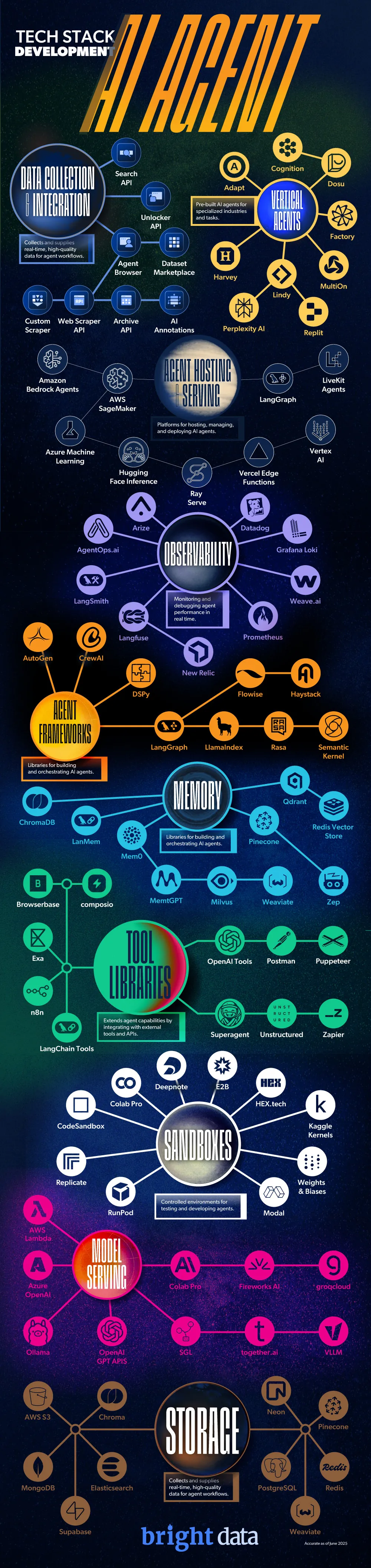
Source: Bright Data


